Regional guides
Date published:
Last updated:

By
Harrison Downes
*Researched and regularly updated to reflect current data.*
The Costa del Sol is the most established international property market in Spain. Foreign buyers account for over 40% of all property transactions in Malaga province, and the infrastructure for international purchases - English-speaking agents, lawyers, banks, and brokers - is more developed here than anywhere else in the country.
Prices range from around 2,500 euros per square metre in areas like Fuengirola and Benalmadena to well over 6,000 euros in parts of Marbella's Golden Mile. The market saw strong growth of 12-17% across 2025, driven by continued international demand, limited supply in premium areas, and improved transport links including direct flights from across Europe and beyond.
This guide covers the current market conditions, what a mortgage looks like for Costa del Sol property, the specific buying costs in Andalucia, and what to expect in the key areas along the coast.
Check your mortgage eligibility for Costa del Sol property →
At a glance
Foreign buyers make up over 40% of transactions in Malaga province
Average prices range from ~2,500 euros/sqm (Fuengirola) to 6,000+ euros/sqm (Marbella Golden Mile)
Prices grew 12-17% across the province in 2025
Andalucia's ITP (property transfer tax) is 7% - one of the lower rates in Spain
Non-resident mortgage terms are the same as anywhere in Spain: 60-70% LTV, 2.55-3.80% fixed
Strong rental demand, particularly for short-term holiday lets in coastal areas
Malaga airport (AGP) has direct connections to over 130 destinations
British buyers are the largest foreign group, followed by Scandinavians, Germans, and Dutch
The Costa del Sol property market in 2026
The Costa del Sol stretches roughly 150 kilometres along the southern coast of Malaga province, from Nerja in the east to Manilva near Gibraltar in the west. Within that stretch, you'll find everything from high-rise beachfront apartments to sprawling hilltop villas, golf resort properties, and new-build developments.
The market has been on a sustained upward trajectory. Property prices in Malaga province grew between 12% and 17% in 2025 depending on the specific area and property type. New-build activity has increased, particularly in Estepona and east of Malaga city, but supply remains well below demand in the most sought-after locations.
Average prices by area (approximate, early 2026):
Area | Avg. price per sqm | Typical property types |
|---|---|---|
Marbella (Golden Mile / Puerto Banus) | 5,500-7,000+ euros | Luxury villas, beachfront apartments, gated communities |
Marbella (town / east) | 3,500-5,000 euros | Apartments, townhouses, villas |
Estepona | 3,000-4,500 euros | New developments, townhouses, apartments |
Benahavis | 3,500-5,500 euros | Villas, golf properties, gated urbanisations |
Fuengirola / Benalmadena | 2,500-3,500 euros | Apartments, townhouses, established urbanisations |
Mijas (coast and pueblo) | 2,500-3,500 euros | Mix of apartments, townhouses, and country properties |
Malaga city | 3,000-4,000 euros | Urban apartments, historic centre, new developments |
Nerja / East coast | 2,500-3,500 euros | Apartments, smaller developments |
These are averages - individual properties vary significantly based on exact location, views, condition, and proximity to the beach or golf courses. Beachfront and front-line golf properties command substantial premiums over comparable inland properties.
Foreign buyers dominate the market. British purchasers remain the single largest national group, though their overall share has gradually declined as Scandinavian, Dutch, Belgian, and Eastern European buyer numbers have grown. The buyer mix varies by area: Marbella attracts Middle Eastern and Northern European buyers at the luxury end, while Fuengirola and Benalmadena have large established British and Scandinavian communities. Estepona has seen rapid growth from a broader European base.
Getting a mortgage for Costa del Sol property
Non-resident mortgage terms for Costa del Sol property are the same as anywhere else in Spain - there's no regional variation in mortgage products. What does vary is which banks have the strongest presence in the area and the most experience with local property types.
Rates: Non-resident fixed rates currently range from approximately 2.55% to 3.80%. Variable rates sit at Euribor + 1.0-2.5%. These figures apply nationally. For the full bank-by-bank breakdown, see our rate comparison.
LTV: 60-70% for non-residents, meaning a deposit of 30-40% of the property price.
Banks active on the Costa del Sol: All major non-resident lenders operate in Malaga province. UCI and Sabadell both have a strong broker network along the coast. CaixaBank's HolaBank digital platform works from anywhere. Santander has branches throughout the area. For luxury purchases above 500,000 euros, several banks are willing to discuss individually negotiated terms.
Property types and bank preferences: Standard apartments and townhouses in established urbanisations are straightforward for banks to finance. Larger villas, rural fincas, and properties in less accessible locations may face lower valuations or more conservative LTV offers. Off-plan properties from reputable developers are generally financeable, but the bank will want to see developer bank guarantees and may not release funds until construction reaches certain milestones.
For a detailed comparison of which bank suits which buyer profile, see our bank comparison guide.
Buying costs in Andalucia
Andalucia applies a flat 7% ITP (property transfer tax) on resale properties - one of the lower rates in Spain and notably cheaper than Valencia (10%), Catalonia (10-11%), or the Balearic Islands (8-13%). This lower tax rate is one reason the Costa del Sol remains competitive on total buying costs despite rising property prices.
Here's a worked example for a typical Costa del Sol purchase:
500,000 euro resale apartment in Marbella, 65% LTV mortgage:
Cost | Amount |
|---|---|
Property price | 500,000 euros |
ITP (Andalucia, 7%) | 35,000 euros |
Notary (purchase deed) | 700 euros |
Land Registry | 450 euros |
Legal fees (1%) | 5,000 euros |
Gestor | 400 euros |
Mortgage valuation | 500 euros |
Mortgage arrangement fee (0.5% of 325,000) | 1,625 euros |
Total buying costs | ~43,675 euros |
Deposit (35%) | 175,000 euros |
Total cash needed | ~218,675 euros |
For comparison, the same property in Valencia would cost 50,000 euros in ITP alone (10%), adding 15,000 euros to the total. In the Balearic Islands, ITP on a 500,000 euro property works out to approximately 44,500 euros on the sliding scale.
For the full cost breakdown and regional comparisons, see our complete buying cost guide. For ITP rates across all 17 regions, see our ITP guide.
Key areas for international buyers
Marbella and the Golden Mile
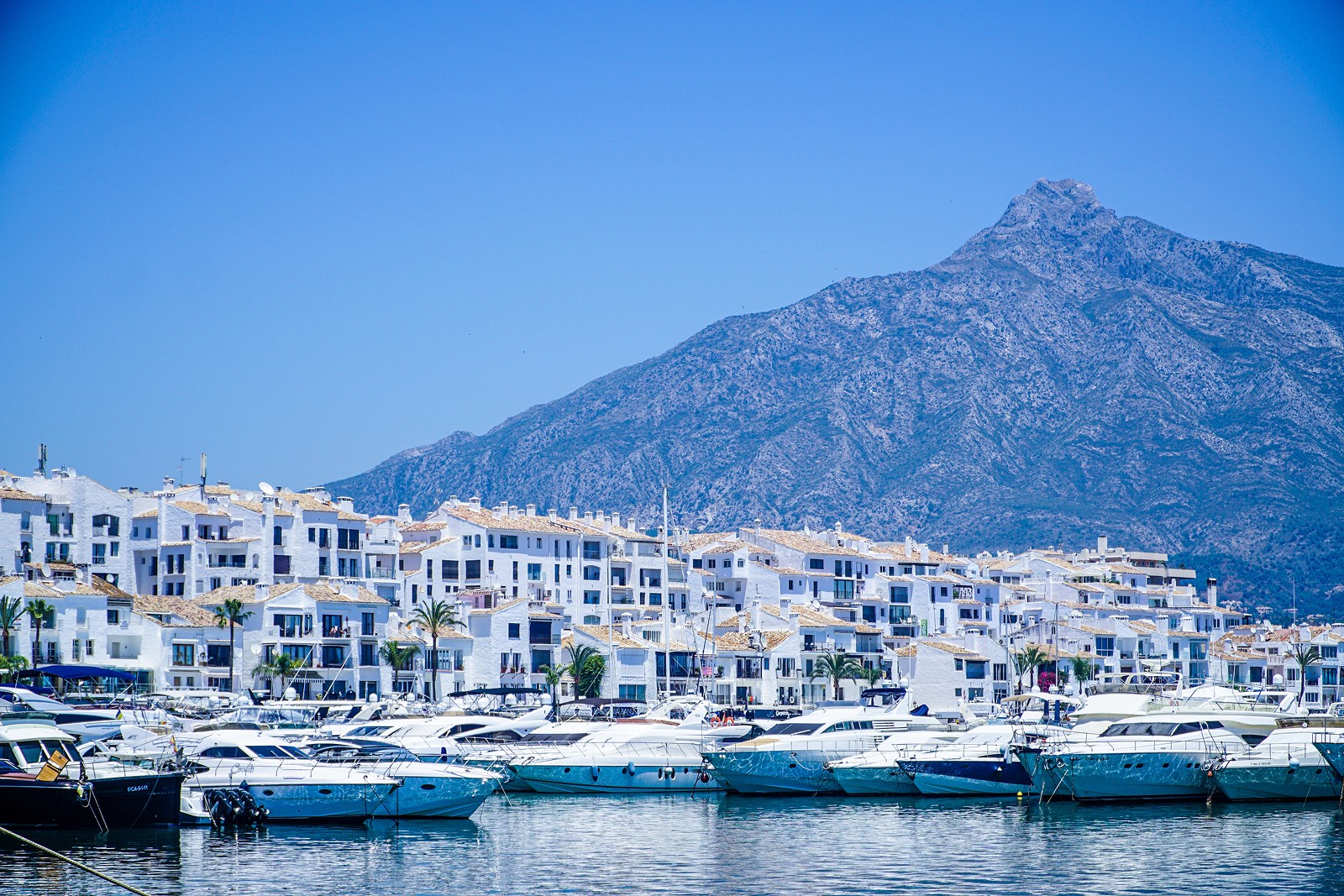
Marbella is the flagship of the Costa del Sol's luxury market. The Golden Mile - the stretch between Marbella town and Puerto Banus - is home to some of the most expensive real estate in Spain, with beachfront villas and penthouses regularly exceeding 3-5 million euros.
Beyond the ultra-premium segment, Marbella offers a broader range of property. The old town has charming townhouses and apartments. East Marbella (towards Elviria and Cabopino) is more residential with family-oriented urbanisations at lower price points. The Nueva Andalucia area behind Puerto Banus is popular with golf-oriented buyers.
Rental demand is strong year-round but peaks sharply in summer. Marbella attracts high-spending tourists, which supports premium nightly rates for well-located, well-presented properties.
The buyer mix is international and affluent: British, Scandinavian, German, Dutch, Belgian, Middle Eastern, and increasingly Eastern European. Russian buyer activity has declined significantly since 2022.
Estepona
Estepona has been one of the fastest-growing property markets on the Costa del Sol over the past five years. The town has invested heavily in its old centre (a well-regarded beautification programme with murals, flower displays, and pedestrianised streets), and new-build development has expanded significantly along the coast and into the hillside.
Prices are lower than Marbella but have been catching up. The range of 3,000-4,500 euros per square metre offers significantly more space and quality for the money than equivalent Marbella purchases. New developments from established promoters are a particular strength of the Estepona market.
The buyer profile is broadly European - British, Scandinavian, Dutch, and Belgian buyers are prominent. Estepona appeals to buyers who want proximity to Marbella's amenities without Marbella's prices.
Fuengirola and Benalmadena
These neighbouring towns represent the more established, mid-range end of the Costa del Sol market. Both have large existing expat communities (particularly British and Scandinavian), good public transport links to Malaga city via the Cercanias commuter train, and a wide range of amenities, restaurants, and services catering to international residents.
Prices are among the most accessible on the western Costa del Sol at 2,500-3,500 euros per square metre. The property stock is largely apartments and townhouses in established urbanisations, many dating from the 1990s-2000s. New-build activity is more limited than in Estepona but growing.
These areas suit buyers looking for an established community, year-round services, and good transport links at a more moderate price point. Rental yields can be attractive given the lower purchase prices, particularly for long-term lets to the resident expat population.
Malaga city
Malaga has transformed over the past decade from a transit point (airport, then transfer to the coast) into a destination in its own right. The historic centre has been extensively renovated, with museums (including the Pompidou Centre and Picasso Museum), restaurants, and cultural events drawing visitors year-round. The growing tech sector (Google has a cybersecurity hub here) has added a younger, professional demographic.
Property in Malaga city is urban apartment stock - there are few villas or houses within the city proper. Prices in the centre and beachfront areas run 3,000-4,000 euros per square metre, with premium historic buildings and new developments at the higher end.
The city appeals to buyers who want an urban lifestyle with beach access rather than a resort environment. Transport links are excellent: the airport is 15 minutes from the centre, and the AVE high-speed rail connects to Madrid in 2.5 hours. Rental demand is strong from both tourists and the growing professional population.
Mijas and the inland areas
Mijas Costa (the coastal section) offers prices and character similar to Fuengirola and Benalmadena. Mijas Pueblo (the hilltop village) and other inland areas provide a more traditional Andalucian experience with lower prices, more space, and countryside surroundings.
Inland properties can offer excellent value - larger villas with land and views at prices below coastal apartments. The trade-off is distance from the beach (typically 15-30 minutes by car), more limited public transport, and less international infrastructure. Rental potential for inland properties is generally lower and more seasonal than coastal equivalents.
Banks may apply more conservative valuations to rural and inland properties, which could result in lower LTV offers. If you're financing an inland purchase, it's worth checking the likely valuation with your broker before committing.
Rental potential and regulations
The Costa del Sol benefits from strong rental demand across most of the year. Summer (June-September) commands the highest rates, but the mild winter climate supports year-round occupancy from long-stay visitors, remote workers, and retirees escaping Northern European winters.
Typical gross rental yields for well-located Costa del Sol properties range from 4% to 7%, depending on the area, property type, and whether you're renting short-term (tourist) or long-term. Short-term holiday rentals in premium locations can achieve higher gross returns but come with higher management costs and more regulatory complexity.
Tourist rental licensing: Holiday rental properties in Andalucia require a VFT licence (Vivienda con Fines Turisticos) from the Junta de Andalucia. The application requires the property to meet specific standards (safety, accessibility, inventory) and to be registered with the tourism authorities. Properties must display the VFT registration number in all advertising.
Andalucia's approach to tourist rental regulation has been more permissive than Barcelona's or the Balearic Islands', but regulations are tightening. Some municipalities are introducing restrictions on new tourist licences in areas with high tourist density. If rental income is part of your investment strategy, verify the current licensing situation for your target area before purchasing.
For information on how rental income is taxed, see our non-resident tax guide.
Practical considerations
Airport access. Malaga-Costa del Sol Airport (AGP) is one of Spain's busiest, with direct flights to over 130 destinations across Europe, North Africa, and the Middle East. Budget airlines (Ryanair, easyJet, Vueling, Norwegian) provide frequent, affordable connections. The airport is centrally located along the coast - roughly 30 minutes from Marbella, 15 minutes from Fuengirola, and 10 minutes from Malaga city centre.
Transport. The AP-7 motorway runs the length of the coast (toll-free since 2020). The Cercanias commuter train connects Malaga city, the airport, Torremolinos, Benalmadena, and Fuengirola. A car is generally necessary for areas west of Fuengirola or inland. An extension of the commuter rail to Marbella and Estepona has been discussed for years but construction has not yet begun.
Healthcare. The Costa del Sol has both public hospitals (Hospital Costa del Sol in Marbella, Hospital Regional in Malaga) and a well-developed private healthcare sector. Several private hospitals cater to international patients with English-speaking staff. Non-residents can access private healthcare through insurance; public healthcare access depends on your residency and social security status.
International schools. The Costa del Sol has a concentration of international schools, particularly in the Marbella-Benahavis area. Options include British, American, Swedish, German, and French curriculum schools. Availability and quality vary - research specific schools well in advance if this is a factor in your purchase decision.
Climate. The Costa del Sol averages over 300 days of sunshine per year. Summers are hot (30-35°C) but mitigated by coastal breezes. Winters are mild (12-18°C daytime) with occasional rain, particularly November-February. The microclimate created by the mountains behind the coast provides some protection from cold northerly winds.
Frequently asked questions
Is the Costa del Sol still good value compared to other Mediterranean destinations?
On a price-per-square-metre basis, the Costa del Sol sits in the middle of the Spanish coastal market - more expensive than Valencia/Costa Blanca and the Canary Islands, but significantly cheaper than Mallorca and comparable to mid-range Barcelona suburbs. Compared to the French Riviera, Italian Amalfi Coast, or Croatian coast, it remains competitive. The 7% ITP rate in Andalucia helps keep total buying costs lower than higher-tax regions.
Which area has the best rental yield?
Lower-priced areas with strong tourist demand tend to offer the highest gross yields. Fuengirola, Benalmadena, and Torremolinos can achieve 5-7% gross on well-managed tourist rentals. Marbella's luxury market has lower percentage yields but higher absolute returns. Malaga city offers strong long-term rental demand with moderate yields.
Is Estepona still a good investment, or has it become too expensive?
Estepona has seen rapid price growth but still offers 20-40% lower prices per square metre than equivalent Marbella property. As long as that gap persists, and new infrastructure (schools, commercial centres, road improvements) continues to develop, Estepona retains its value proposition. The question is whether you're buying at the right point in its growth curve - something a local agent can help you assess.
Do I need a car on the Costa del Sol?
In Malaga city and along the commuter train corridor (Torremolinos to Fuengirola), you can manage without a car for daily life. West of Fuengirola, including Marbella and Estepona, a car is effectively essential. For inland properties, a car is mandatory.
How does the Costa del Sol compare to the Costa Blanca?
The Costa Blanca (Alicante province) is significantly cheaper, with prices 30-50% lower than equivalent Costa del Sol property. It has a larger established expat community (particularly British) and arguably more sunshine. The Costa del Sol offers more developed luxury infrastructure, a wider range of international schools, and better long-haul flight connections. The choice often comes down to budget and whether you prioritise lifestyle/amenity range or value for money. See our Valencia and Costa Blanca guide for a full comparison.
Next steps
If you're considering buying on the Costa del Sol, the most useful first step is understanding what you can borrow and what the total costs look like for your target price range. Our free pre-check gives you a clear picture within 48 hours.
For the full mortgage process, see our complete guide to getting a mortgage in Spain as a non-resident. For a comparison with other Spanish regions, see our regional guide.
Questions? WhatsApp us or get in touch.
This content is for informational purposes only and does not constitute financial, legal, or investment advice. Zerodown is a mortgage introducer, not a lender, financial advisor, or property agent. Property prices and market conditions change. Always conduct your own research and seek independent professional advice before purchasing.