Regional guides
Date published:
Last updated:

By
Harrison Downes
*Researched and regularly updated to reflect current data.*
Barcelona is Spain's second most expensive property market after the Balearic Islands, and one of the most complex for international buyers. The city combines strong capital appreciation, excellent infrastructure, and global lifestyle appeal with some of the highest buying costs in the country (Catalonia's 10-11% transfer tax), increasingly strict rental regulations, and a tourist accommodation moratorium in parts of the city.
Average prices across the city range from around 3,000 euros per square metre in outer neighbourhoods to over 6,000 in premium central locations. The market grew 9-13% across Barcelona province in 2025, driven by limited supply, strong international and domestic demand, and the city's growing reputation as a tech and digital nomad hub.
This guide covers the current market, what a mortgage looks like for Barcelona property, Catalonia's specific buying costs, and what to expect in the key neighbourhoods for international buyers.
Check your mortgage eligibility for Barcelona property →
At a glance
Barcelona property prices range from ~3,000 euros/sqm (outer areas) to 6,000+ euros/sqm (premium central)
Prices grew 9-13% across Barcelona province in 2025
Catalonia's ITP is 10% (11% above 1,000,000 euros) - one of the highest in Spain
Non-resident mortgage terms are the same nationally: 60-70% LTV, 2.55-3.80% fixed
Tourist rental licensing is severely restricted in much of the city centre
Long-term rental market is subject to rent control measures
Strong international buyer presence, particularly European and Latin American
Excellent transport: El Prat airport, AVE high-speed rail to Madrid (2.5 hours), extensive metro
The Barcelona property market in 2026
Barcelona's property market is characterised by constrained supply and persistent demand. The city is geographically limited - squeezed between the sea and the Collserola hills - and new-build activity is modest relative to population and demand. This structural supply deficit has driven sustained price growth.
Prices grew between 9% and 13% across Barcelona province in 2025 depending on the neighbourhood and property type. The city proper saw stronger growth than the surrounding metropolitan area. New-build prices grew faster than resale, reflecting both construction cost inflation and buyer preference for modern, energy-efficient stock.
Average prices by neighbourhood (approximate, early 2026):
Neighbourhood | Avg. price per sqm | Character |
|---|---|---|
Sarria-Sant Gervasi | 5,500-6,500 euros | Premium residential, families, international schools |
Eixample (central) | 4,500-5,500 euros | Classic grid layout, Gaudi architecture, restaurants |
Ciutat Vella (Gothic/Born/Raval) | 3,500-5,000 euros | Historic centre, tourism-heavy, mixed quality |
Gracia | 4,000-5,000 euros | Village feel, trendy, younger demographic |
Poblenou / 22@ | 4,000-5,000 euros | Tech district, modern development, beach access |
Les Corts | 4,500-5,500 euros | Residential, FC Barcelona stadium area, quieter |
Sant Marti (general) | 3,500-4,500 euros | Broad district, varies by sub-neighbourhood |
Horta-Guinardo | 2,800-3,500 euros | Residential, more local, lower prices |
Nou Barris | 2,000-2,800 euros | Most affordable, least international |
The buyer mix in Barcelona is more diverse than the coastal markets. European buyers (French, Italian, German, Dutch, British) are well represented, alongside a significant Latin American contingent and growing interest from US buyers attracted by the tech scene and Digital Nomad Visa. The luxury market, particularly in Sarria-Sant Gervasi and upper Eixample, attracts Middle Eastern and Northern European high-net-worth buyers.
Unlike the Costa del Sol, where foreign buyers dominate many local markets, Barcelona's property market is primarily driven by domestic demand. International buyers represent a meaningful but minority share of total transactions. This means you're competing with local buyers as well as other internationals, which can make the market more competitive on well-priced properties.
Getting a mortgage for Barcelona property
Non-resident mortgage terms for Barcelona are the same as anywhere in Spain. There's no regional variation in mortgage products - the differences are in buying costs (taxes), not financing terms.
Rates: Non-resident fixed rates currently range from approximately 2.55% to 3.80%. Variable rates sit at Euribor + 1.0-2.5%. See our rate comparison for the full bank-by-bank breakdown.
LTV: 60-70% for non-residents.
Banks in Barcelona: All major non-resident lenders operate in Barcelona. CaixaBank is headquartered in the city and has the densest branch network. Sabadell (originally a Catalan bank) also has a strong local presence. UCI, Santander, and Bankinter all have Barcelona operations.
New-build vs resale implications: Barcelona has both a resale market (the majority) and a growing new-build segment. The tax treatment differs significantly. Resale properties attract ITP at 10-11%. New builds attract 10% IVA plus 1.5% AJD (stamp duty). On a 600,000 euro property, that's the difference between 60,000 euros (ITP on resale) and 69,000 euros (IVA + AJD on new build). For properties above 1,000,000 euros, the 11% ITP rate on the portion above the threshold makes resale slightly more expensive in percentage terms.
Buying costs in Catalonia
Catalonia has one of the highest property transfer tax rates in Spain. This is a significant cost factor and worth understanding in detail before budgeting.
ITP (resale properties): 10% on the first 1,000,000 euros of the purchase price, 11% on any amount above 1,000,000 euros.
IVA + AJD (new builds): 10% IVA plus 1.5% AJD in Catalonia (one of the highest AJD rates nationally).
For comparison: the same 500,000 euro resale property costs 50,000 euros in ITP in Catalonia, 35,000 in Andalucia (7%), and 30,000 in Madrid (6%). That's a 20,000 euro difference between Barcelona and Madrid on identical property value.
Worked example: 700,000 euro resale apartment in Eixample, 65% LTV mortgage:
Cost | Amount |
|---|---|
Property price | 700,000 euros |
ITP (Catalonia, 10%) | 70,000 euros |
Notary (purchase deed) | 850 euros |
Land Registry | 550 euros |
Legal fees (1%) | 7,000 euros |
Gestor | 450 euros |
Mortgage valuation | 500 euros |
Mortgage arrangement fee (0.5% of 455,000) | 2,275 euros |
Total buying costs | ~81,625 euros |
Deposit (35%) | 245,000 euros |
Total cash needed | ~326,625 euros |
For the complete regional tax comparison and worked examples at other price points, see our cost breakdown guide and our ITP rates by region.
Key neighbourhoods for international buyers
Eixample
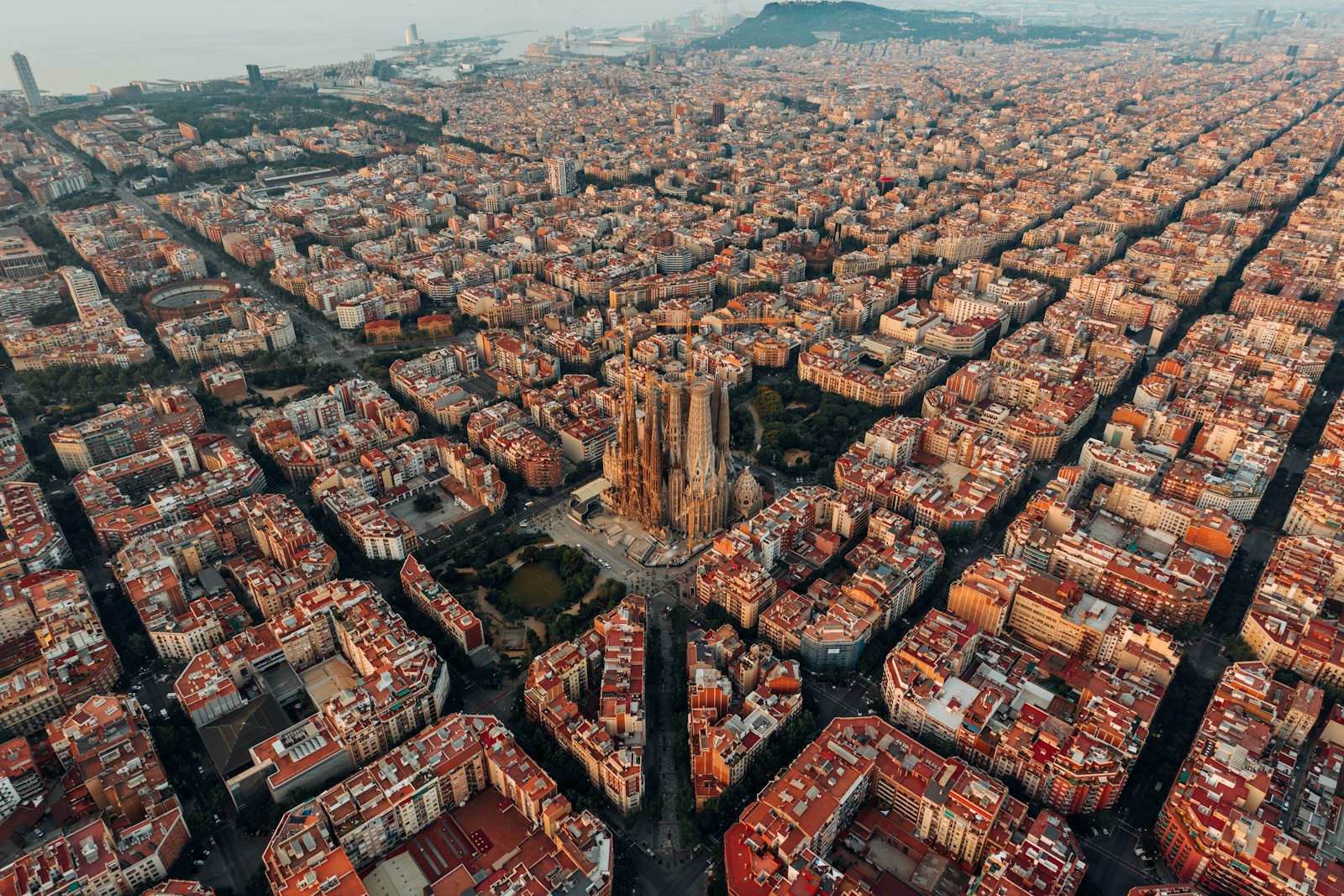
Eixample is the quintessential Barcelona neighbourhood and the area most international buyers consider first. The grid layout designed by Ildefons Cerda in the 19th century creates wide, tree-lined avenues with distinctive chamfered corners. The architecture is a mix of Modernista buildings (Gaudi's Casa Batllo and La Pedrera are here), elegant 19th-century apartment blocks, and some newer developments.
Property in central Eixample (Dreta de l'Eixample, around Passeig de Gracia) commands 5,000-6,000+ euros per square metre. Left Eixample (Esquerra de l'Eixample) and the area around the Sagrada Familia are slightly more affordable at 4,500-5,500 euros. Apartments are typically large by Barcelona standards - 80-120 sqm for a 2-3 bedroom is common - reflecting the generous building plans of the original layout.
Rental demand is strong for both long-term and short-term lets, though tourist rental licensing in much of Eixample is restricted. Long-term rental yields are moderate (3-4%) given the higher purchase prices, but capital appreciation has been consistent.
Eixample suits buyers who want a central location with excellent restaurants, shopping, and cultural access, combined with a residential feel once you step off the main avenues.
Gracia
Gracia feels like a separate village that happened to be absorbed by the expanding city. Narrow streets, small plazas, independent shops, and a strong sense of community give it a character distinct from the rest of Barcelona. It's popular with younger professionals, creatives, and families who want urban living without the tourist intensity of the centre.
Prices range from 4,000 to 5,000 euros per square metre. Apartments tend to be smaller than Eixample - older buildings with charming but compact layouts. New-build and renovated options are limited by the neighbourhood's dense, historic fabric.
Gracia has a strong long-term rental market driven by local and international professionals. Tourist rental licensing is restricted. For buyers, the appeal is lifestyle rather than investment return - it's a neighbourhood people choose because they want to spend time there, not because the yield calculations are optimal.
Poblenou and the 22@ district
Poblenou has undergone the most dramatic transformation of any Barcelona neighbourhood over the past decade. The former industrial area has been reimagined as a tech and innovation district (22@), attracting companies including Amazon, Cisco, Meta, and a dense cluster of startups. The conversion of old factories into loft-style apartments, co-working spaces, and restaurants has created a distinct neighbourhood identity.
Prices range from 4,000 to 5,000 euros per square metre, with new developments at the higher end. The area has direct beach access (a significant plus in Barcelona, where most central neighbourhoods are inland), good metro connections, and a growing food and nightlife scene.
The tech sector presence supports strong rental demand from professionals on relocation packages. Long-term yields of 4-5% are achievable on well-located apartments. Poblenou suits buyers looking for a modern, forward-looking neighbourhood with beach access and growth potential.
Sarria-Sant Gervasi
Sarria-Sant Gervasi is Barcelona's premium residential district, located on the hillside above the city centre. It's the neighbourhood of choice for affluent families, diplomats, and senior executives. The area is quieter and greener than the central districts, with wider streets, detached and semi-detached houses (rare in Barcelona), and proximity to several international schools.
Prices are the highest in Barcelona at 5,500-6,500 euros per square metre, with premium properties exceeding 7,000. The property stock includes apartments in elegant buildings, townhouses, and some villas with gardens - a rarity in a city where apartments dominate.
Sarria-Sant Gervasi is less about rental yield and more about quality of life. The international school cluster (Benjamin Franklin, British School, Kensington School, American School of Barcelona are all accessible) makes it the default choice for families relocating to the city. If you're buying for personal use and have school-age children, this is likely where you'll end up looking.
Barceloneta and Vila Olimpica
Barceloneta is Barcelona's historic fishing quarter, now a popular beachfront neighbourhood with a mix of original narrow-street character and modern waterfront development. Vila Olimpica, built for the 1992 Olympics, is more modern and planned.
Prices in Barceloneta range from 4,000 to 5,500 euros per square metre for apartments. Vila Olimpica runs slightly higher for the modern stock. The area's proximity to the beach, city centre, and the port makes it appealing for both personal use and rental.
The critical consideration here is tourist rental licensing. Barcelona's city government has taken an increasingly restrictive approach to tourist accommodation, and Barceloneta has been at the centre of that debate. New tourist rental licences in much of Barceloneta are not being issued, and existing licences are under scrutiny. If short-term rental income is part of your investment thesis, verify the current licensing situation very carefully before purchasing.
Ciutat Vella (Gothic Quarter, Born, Raval)
Ciutat Vella encompasses Barcelona's oldest neighbourhoods. The Gothic Quarter and Born are architecturally stunning with medieval streets, historic buildings, and a dense concentration of restaurants, bars, and cultural attractions. Raval is grittier and more ethnically diverse, with rapidly gentrifying pockets alongside more challenging areas.
Prices vary significantly within Ciutat Vella - from 3,500 euros per sqm in parts of Raval to 5,000+ in the heart of the Gothic Quarter or Born. Property quality is extremely variable. Many buildings are centuries old with limited modernisation, and renovation costs can be substantial.
The tourist rental moratorium applies across much of Ciutat Vella. For long-term rental, demand is strong but Barcelona's rent control measures (see below) apply. Buying in Ciutat Vella is more of a lifestyle and capital appreciation play than a rental yield strategy.
Rental market and regulations
Barcelona has the most complex rental regulatory environment of any major Spanish city. International buyers considering rental income need to understand two separate frameworks.
Tourist rental (short-term)
Barcelona's city government has been progressively restricting tourist rental activity. In 2024-2025, the city announced plans to phase out all tourist rental licences by 2028, though the legal and practical implementation of this remains contested. As of early 2026, no new tourist rental licences are being issued in most central districts, and the transfer of existing licences is heavily restricted.
If you're buying specifically for short-term tourist rental income in Barcelona city, this is a significant risk. The regulatory direction is clearly towards restriction, and any investment thesis that depends on tourist rental income should account for the possibility that the licence may not be available or may be revoked.
Outside Barcelona city, the surrounding metropolitan area and Catalan coast have different (generally less restrictive) tourist rental regulations.
Long-term rental
Barcelona (and Catalonia more broadly) has implemented rent control measures that limit how much landlords can charge on new rental contracts. The reference index (Index de preus de lloguer) sets maximum rents based on the property's location, size, and characteristics. Landlords cannot set rents above the index level for new contracts in regulated zones.
These controls primarily affect landlords who might otherwise charge above-market rents. For most standard rental properties, the reference index broadly reflects market rates. However, the regulations add administrative complexity and limit upside potential.
Long-term rental yields in Barcelona typically run 3-5% gross depending on the neighbourhood and property type. After management costs, maintenance, taxes, and insurance, net yields of 2-3.5% are more realistic.
For how rental income is taxed, see our non-resident tax guide.
Practical considerations
Airport. Barcelona-El Prat Airport (BCN) is one of Europe's busiest, with direct flights to destinations across Europe, North Africa, the Middle East, and the Americas. Budget and full-service carriers operate extensive networks. The airport is connected to the city centre by metro (L9), Aerobus, and taxi (roughly 30-40 minutes to the centre).
Public transport. Barcelona's metro, bus, and tram network is excellent. Most central neighbourhoods are well-served, and the monthly travel pass (T-Casual or equivalent) is affordable. A car is generally unnecessary within the city and often inconvenient given limited parking. For trips outside the city (Costa Brava, Pyrenees, wine country), a car becomes useful.
AVE high-speed rail. Barcelona Sants station connects to Madrid in approximately 2.5 hours, and to other Spanish cities including Zaragoza, Malaga (via Madrid), and Valencia. The French TGV network also connects through Figueres, providing rail access to Paris, Lyon, and other French cities.
International schools. Barcelona has a good selection of international schools across several curricula: British (British School of Barcelona, Kensington School, Oak House), American (American School of Barcelona, Benjamin Franklin), French (Lycee Francais), German (Deutsche Schule), and Swiss (Zurich International School). Most are concentrated in the Sarria-Sant Gervasi / Pedralbes area and the surrounding hills. Demand for places at the most established schools is high - register early.
Healthcare. Barcelona has excellent healthcare facilities. The public system includes major hospitals (Hospital Clinic, Hospital de la Santa Creu i Sant Pau, Hospital del Mar). The private sector is well-developed with English-speaking services. Non-residents typically use private healthcare through insurance.
Language. Barcelona is bilingual - Catalan and Spanish (Castellano) are both official languages. Catalan is the language of the regional government, schools, and much of daily life. Spanish is universally understood and widely spoken, but awareness of and respect for the Catalan language is important socially and practically. In international business and expat contexts, English is widely spoken.
Frequently asked questions
Is Barcelona too expensive compared to other Spanish cities?
Barcelona is the second most expensive major market in Spain (after Palma de Mallorca), but it offers infrastructure, transport, culture, and international services that smaller cities can't match. Whether it's "too expensive" depends on what you're comparing it to and what you value. It's significantly cheaper than Paris, London, or Munich for equivalent quality of life. See our regional comparison guide for how Barcelona stacks up against other Spanish options.
Can I rent out my Barcelona property to tourists?
Tourist rental licensing in central Barcelona is severely restricted and no new licences are being issued in most districts. The city has announced plans to phase out all tourist licences by 2028. If tourist rental income is essential to your investment case, Barcelona city is not the right market. Surrounding areas have less restrictive regulations.
How does Catalonia's ITP compare to other regions?
Catalonia's 10% ITP (11% above 1,000,000 euros) is among the highest in Spain. Only the Balearic Islands (up to 13% on sliding scale) and Cantabria (10%) are comparable. Madrid at 6% and Andalucia at 7% are significantly cheaper. See our ITP guide for the full comparison.
Is Poblenou still a good investment?
Poblenou has already seen significant price growth as the 22@ tech district has matured. Whether further upside remains depends on the pace of continued tech sector growth and residential development in the area. The neighbourhood's fundamentals - beach access, metro connectivity, and employer proximity - support sustained demand. It's no longer an undiscovered area, but it's also not fully mature.
Do I need to speak Catalan to buy property in Barcelona?
No. The property buying process, mortgage applications, and legal work can all be conducted in Spanish or English. Notary documents are typically in Spanish (Castellano). Day-to-day life in Barcelona is manageable in Spanish, though learning some Catalan is appreciated in social and community contexts.
Next steps
If you're considering buying in Barcelona, the first step is understanding what you can borrow and what the total costs will look like given Catalonia's higher tax rates. Our free pre-check gives you a clear picture within 48 hours.
For the full mortgage process, see our complete guide to getting a mortgage in Spain as a non-resident. For a comparison with other Spanish regions, see our regional guide.
Questions? WhatsApp us or get in touch.
This content is for informational purposes only and does not constitute financial, legal, or investment advice. Zerodown is a mortgage introducer, not a lender, financial advisor, or property agent. Property prices, regulations, and market conditions change. Always conduct your own research and seek independent professional advice before purchasing.